The book behind the counter
The corner shop of a small town ran on a single spoken sentence:
“Put it on my account.”
The shopkeeper knew your name, your children, what you bought on Fridays and what you owed since March. That was the service, and it kept people coming back.
He did not carry any of it in his head. He wrote it up in a ledger behind the counter every evening after closing, which is why a new assistant could greet you like family on their first morning: your page had been waiting for him. The ledger belonged to the shop. You could not take your page home, most customers never saw the book at all, and fewer still asked what was written next to their name.
Your AI assistant runs the same arrangement. The difference is that this shop has to show you the book if you ask.
What you thought was happening
The assistant remembers your project from last month, so the natural picture is a friendship: all those conversations have gradually changed it, the way shared history changes a colleague, and somewhere in the machine there is a version that has learned you. The opposite picture is equally common, that nothing persists and every chat starts blank.
I held the friendship picture until it turned on me. Months ago I sketched out an assistant of my own and called it Lintilla. Three days later OpenClaw was released. It was the better idea, and the implementation underneath it was far more powerful than anything I had planned, which stayed true through the long list of problems people have documented since. I spent time in both, and I stopped building mine.
My assistant carried on regardless. It still brings Lintilla into my brainstorms and runs speculative research off the back of it, and it irritates me every time. When I went looking for the stored memory so I could delete it, there was no entry to find.
Neither picture explains that.
The file
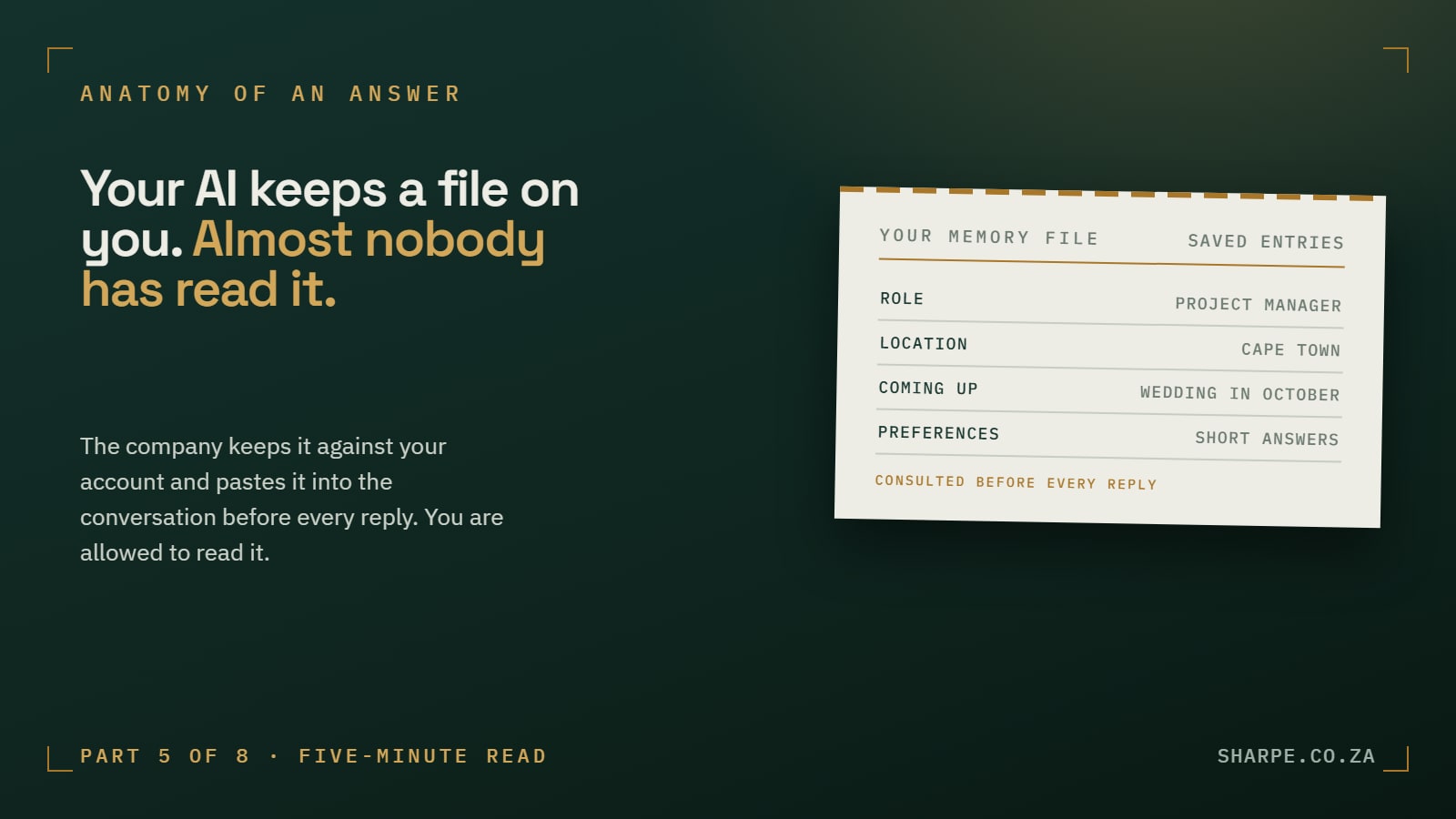
The model itself is frozen. Nothing you type changes its weights. What changes is a file the company keeps alongside your account, and as you chat, the assistant writes entries into it: your role, your standing preferences, whatever you are working on this month. Before each new conversation the relevant entries are pasted invisibly into the context alongside your question, carried in by part one’s codebook like any other text. The model reads that it is talking to a project manager in Cape Town with a wedding in October, and greets you accordingly.
Memory is a file about you, stored by the company and pasted into your prompt before the model sees the question.
The major assistants all now run some version of this. In April 2025, ChatGPT’s memory grew from saved notes into referencing your whole chat history; Claude and Gemini followed with their own variants through 2025. The mechanics differ and the controls move too often to catalogue here, but the shape is stable: saved entries you can inspect, plus impressions drawn from past chats, injected as text. The writer Simon Willison called his own file “a memory dossier”.
Memory and training get mixed up more than anything else on this table, and they are two different switches. Whether your conversations are used to train future models is a separate question with a separate policy, covered in Off the Record. This one is nearer and more personal: a file consulted before every reply, held by the company rather than by you. My Lintilla entry is in there somewhere, under a heading I have not guessed.
What to do with it
Read your file today. Every major assistant has a memory page in its settings, usually under a heading like memory or personalisation (the wording moves). Open it and read what the machine consults before it speaks to you. Whatever keeps feeding Lintilla back into my sessions does not appear on my page at all, so treat the visible file as a partial view rather than the whole book.
Then edit like an owner. Delete what is wrong or out of date, and add the two or three facts you keep re-explaining at the start of every chat, so the file earns its keep.
For conversations that should never enter the book, every major assistant now offers a temporary or incognito mode. For work that should never reach anyone’s counter at all, a capable model can run on your own machine.
Start with the reading, though. Most people have never opened the page at all.
Next on the table
Next week, the skill. You will learn why the best prompt in your company should be a document instead of a person, and what a bomber crash in 1935 taught aviation about exactly this.