Too much aeroplane
On 30 October 1935, the most advanced aircraft in the world took off from Wright Field in Ohio with the Army Air Corps’ chief test pilot at the controls. Boeing’s Model 299, the prototype of what became the B-17, climbed to three hundred feet, stalled and fell out of the sky. Major Ployer Hill died. Boeing’s own chief test pilot, Leslie Tower, aboard as an observer, died of his injuries three weeks later.
The inquiry found nothing wrong with the machine. Hill, one of the most experienced pilots alive, had forgotten one step: a lock that held the tail surfaces still on the ground was never released. The verdict that stuck, handed down by an unnamed newspaper as the story is always told, was that the 299 was:
“Too much airplane for one man to fly.”
No better pilot existed, so the fix was a piece of paper: a short list of checks, read aloud before every flight.
With the checklist, by one Air Force account, crews flew the first twelve aircraft 1.8 million miles without a serious accident, and the pilot’s checklist has governed aviation ever since.
From then on every crew flew with the same checks, whoever was at the controls.
What you thought was happening
Every office now has someone who is good with AI. They phrase things a certain way, they know the incantation that makes the report come out right, and colleagues forward them work the way villagers once brought problems to the blacksmith.
I was that person for one narrow job: getting the machine to write like me rather than like a press release. The knack lived in my head, and I kept retyping pieces of it into every session.
The natural conclusion is that results depend on a personal knack, and that making a whole team good means making every person clever in the same way, or hiring engineers to build something. Results do depend on the knack, and that is the problem.
The written procedure
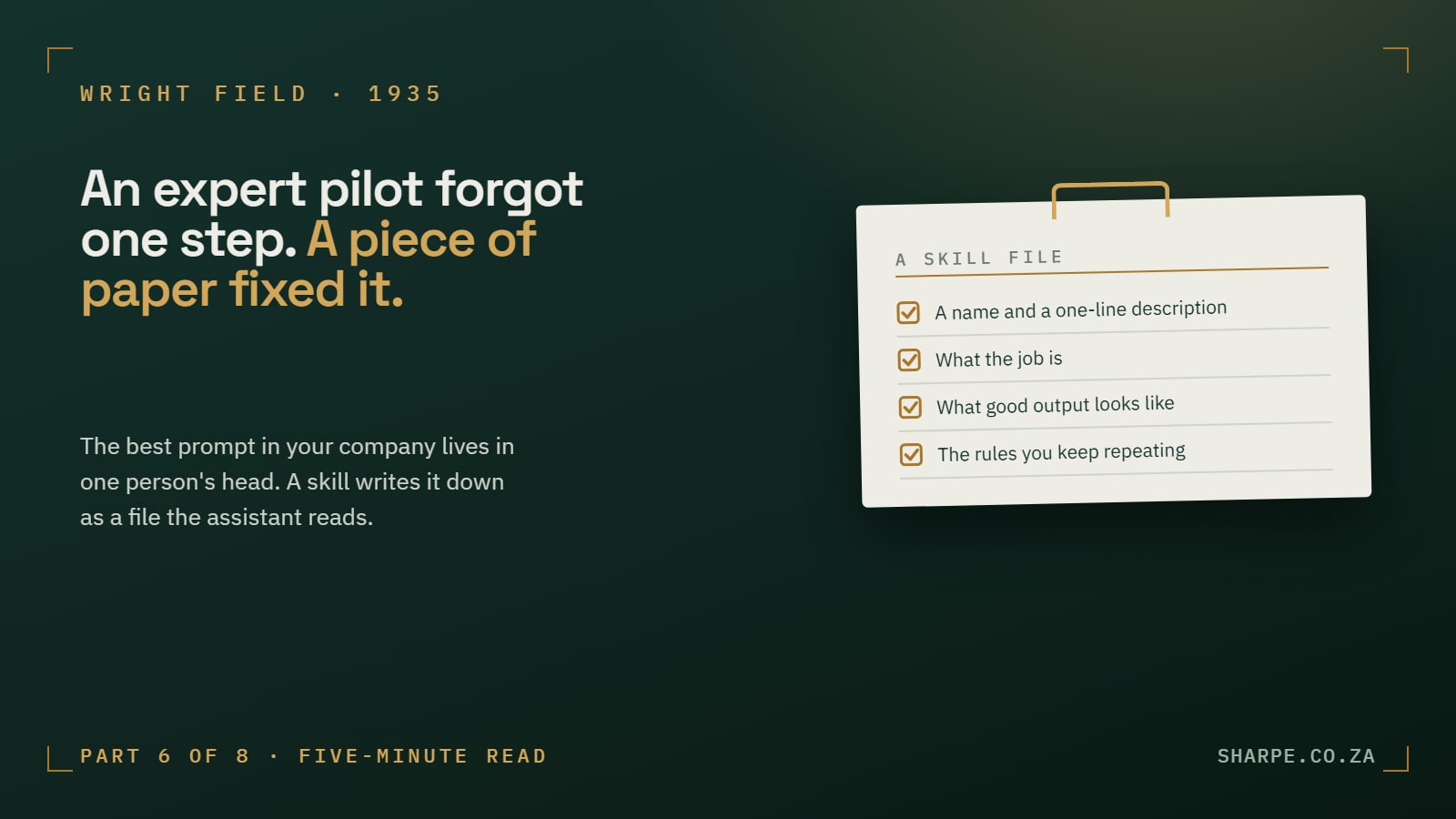
A skill is the checklist, addressed to the machine. In its current common form, launched by Anthropic in October 2025 and released as an open standard that December, a skill is a folder holding one markdown file: plain written instructions with a name and a one-line description at the top. How we write board reports, or how to check a contract against our standard terms. When your request matches the description, the assistant opens the folder and follows the procedure. When it does not, only the one-line description occupies its attention, a design the trade calls progressive disclosure, and part eight shows why that thrift matters.
A skill is written expertise in a plain file, which the machine reads when a request matches and a colleague can open and correct.
The researcher Simon Willison greeted skills as possibly “a bigger deal than MCP”, the plumbing standard that connects assistants to tools. Plumbing needs engineers. A document needs someone who knows how the job should be done and can write it down, which is to say the same person who was the office knack-holder all along. The earlier attempts at this idea, custom chatbots sealed inside one vendor’s app, proved the demand. The folder of text can be copied, which the sealed versions never could. A skill is a file. You can email it, put it in a repository, hand it to a new starter on their first day, and read the procedure yourself to see exactly what the machine has been told.
So the blacksmith’s phrasing tricks are now in a file the second-best person on the team can edit, and they stay when the blacksmith leaves.
Mine is a file called andre-voice: the rules of how I write, with before-and-after examples, which the machine reads whenever it drafts prose for me. It already needs updating, because the models change and I change. And there is a stranger problem underneath it. I read so much AI writing now that I am starting to sound like it, so the document describing my human voice may soon be describing something that no longer exists. I suspect everyone who works with these machines is drifting the same way, and that dialects of AI are coming.
What to do with it
Find the instructions you have typed more than twice. That is your first skill, already drafted. Mine was the writing voice; yours might be the weekly report. Write it down once, properly: what the job is, what good output looks like, the rules you keep repeating. Save it wherever your assistant keeps skills, custom instructions or project notes.
Then hand the file to the colleague who keeps asking how you did it. Their improvements go into the file, where your next draft starts from their version rather than yours. Treat it as a living document too. I revise mine as the models change and as I do.
When a third-party skill promises to do it all for you, read it before you run it. A skill can carry scripts alongside its instructions, and the assistant will run what it reads.
Next on the table
Next week, the agent. You will learn what changes the moment an answer is allowed to act, and why the safest demonstration of 1914 is the right way to think about it.