The slowest man in London
At the great London chess tournament of 1851, Elijah Williams of Bristol became notorious. His rival Howard Staunton, who suffered through some of the longest of those afternoons, accused him of averaging two and a half hours over a single move, and never forgave him. There was no rule against it. Thinking was free, so Williams bought as much of it as he liked.
The game had to invent a way to price it. Sandglasses appeared in 1861, first in a match and weeks later at the Bristol tournament. The mechanical chess clock, two dials on a seesaw, arrived at the London tournament of 1883 and has governed serious chess ever since. Williams did not live to see it. He died in the London cholera of 1854, three years after the tournament that made his name.
The clock changed nothing about the players. The same grandmaster is a different player at one minute a game and at two hours, and everyone at the board understands why. The brain was fixed and the clock was the only thing anyone could adjust.
Your AI has the same kind of control now. It is the small setting next to the model picker.
What you thought was happening
The control goes by names like effort, thinking time or reasoning. I assumed it was a quality setting. For anything big, a business case or a contract, I turned it all the way up, because I wanted the best answer the machine had in it. It felt like hiring a consultant. You pay more and you get the better one. Turning it down felt like cutting corners on the decision itself.
That is not what happens.
Buying the clock
Part two opened the rough book: a reasoning model writes private working before its fair copy. The effort dial sets how much of that working the model is allowed to do. The model itself is the same at every setting. Its weights and everything it knows are identical whether you ask for a long think or a quick one. What changes is the clock: how long it may sit with your question, drafting and checking in the scratchpad, before it must answer. High effort buys a long think and a bigger bill, because every line of working is billed as output. Low effort buys a move in blitz.
Effort buys thinking time on a brain that stays the same, and time is far cheaper to buy than a bigger brain.
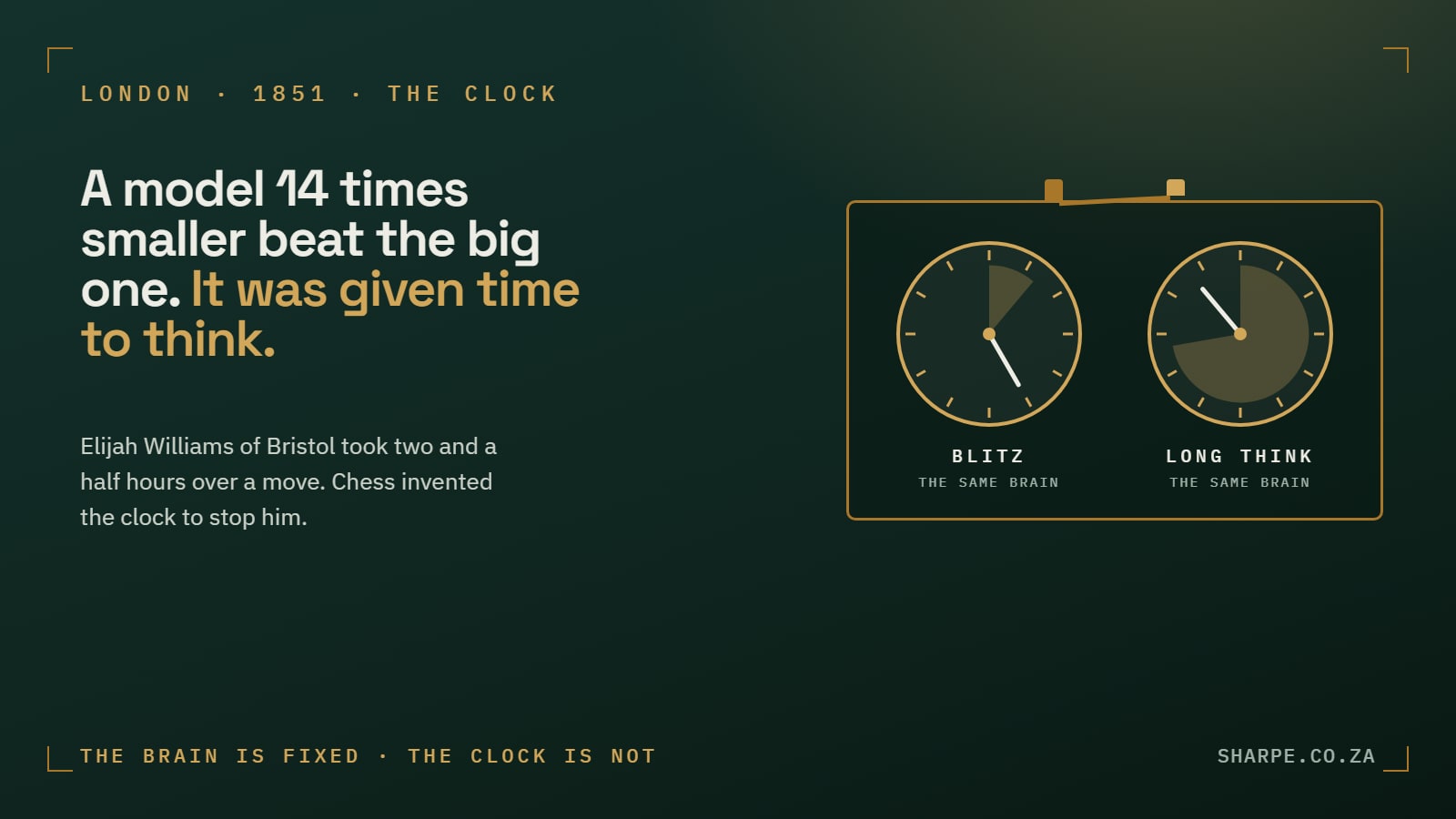
How far time goes surprised me. Researchers at Berkeley and DeepMind showed in 2024 that a small model, given a well-spent thinking budget, can outperform a model fourteen times its size answering directly. Hugging Face reproduced the effect in the open: a three-billion-parameter model beating a seventy-billion-parameter one on a hard mathematics benchmark, purely by thinking longer. The trade goes the other way too. When Anthropic shipped an effort control in late 2025, it reported that its flagship on the middle setting matched its own smaller model’s best coding benchmark score while using seventy-six percent fewer output tokens than that model had needed. The same destination cost a fraction of the ink.
More thinking is not always better, though. On straightforward questions, research keeps finding a point where longer working stops helping and can start hurting, the machine equivalent of talking yourself out of the right answer. And the dial cannot buy knowledge. A model that has never learned a fact will not derive it by staring longer, any more than Williams could think his way to a move in a position he did not understand. I think this is where most of the disappointment with the dial comes from. The question needed a fact the model did not have, and more time gave a longer wrong answer.
So I was half right about the consultant. The top setting does get you the best work the machine can do. It is the same consultant, given the afternoon instead of ten minutes. Whether you have a good consultant or a mediocre one in the first place is the model picker’s job, and that is next week.
What to do with it
Turn the effort down one notch for your routine work and see if you notice. Summaries, rewrites and everyday questions rarely need the long think. I had it set high for everything and was paying for working nobody read.
Then spend on purpose. When the question has steps in it, a contract to pick apart or a plan with dependencies, turn the dial up and let the machine fill its rough book. I still use the top setting for this. It works because the machine gets time to check its own working, and that is what those jobs need.
When an answer disappoints, change the clock before you change the model. A poor reply on low effort tells you more about the seconds you gave it than about the machine. If a long think still comes back wrong, the model probably never had the facts, and the fix is a different model or pasting in the source. Waiting longer will not help.
Keep a rough note of where the dial made a difference for you and where it did not. After a few weeks you will know which of your questions need the long think and which never did.
Next on the table
Next week, the picker. You will learn the four ways models differ, none of them printed on the name, and what happened the day the menu tried to choose for everyone.