A Sunday at Groote Schuur
On 3 December 1967, my father went to work as a nurse at Groote Schuur Hospital in Cape Town.
It was a Sunday.
Somewhere inside that hospital, a 45-year-old South African surgeon named Christiaan Neethling Barnard was preparing to attempt something no human being had successfully done before: transplant a heart from one person into another.
Chris Barnard had been born in Beaufort West on 8 November 1922. He had celebrated his 45th birthday only 25 days earlier. He went to the University of Cape Town to study medicine at the start of the 1940s and qualified as a doctor there in 1945. By the time he entered that operating theatre in December 1967, some twenty-seven years had passed since his first days as a medical student.
The donor was Denise Darvall, a young woman fatally injured in a road accident. The recipient was Louis Washkansky, a grocer dying from advanced heart disease.
Barnard and his team removed Washkansky’s failing heart and replaced it with Darvall’s.
The transplanted heart began to beat.
History was made at Groote Schuur while my father was working in the same hospital.
As a South African, that story has always belonged to the history of my country. As the son of someone who was there that day, it feels personal.
It is a story about courage, science, preparation and extraordinary human ability.
It is also a useful way to think about artificial intelligence.
Because, when you look at the equipment now available, transplanting a human heart should be trivial.
All you need are the right tools.
The right tools
Begin with a modern operating theatre.
Add a cardiopulmonary bypass machine capable of temporarily performing the work of the patient’s heart and lungs.
Add anaesthesia systems, ventilators, invasive monitoring, imaging, blood-gas analysis, coagulation testing, defibrillation, temporary pacing and mechanical circulatory support.
Provide scalpels, clamps, cannulae, retractors, sutures, electrocautery and every specialised cardiac instrument the surgical team could require.
Add sophisticated systems for preserving and transporting the donor organ.
Provide an intensive-care unit filled with equipment capable of measuring, supporting and correcting almost every important function in the human body.
Then improve the package.
Give the team an artificial-intelligence system trained on every relevant anatomy textbook, surgical manual, clinical protocol, case report and transplant paper ever published.
Let it examine scans.
Let it interpret laboratory results.
Let it identify structures in real time.
Let it produce a perfect checklist.
Let it warn when a measurement moves outside its expected range.
Let it recommend the next step.
Add a robotic agent capable of holding instruments without fatigue, maintaining extraordinary precision and executing instructions more steadily than any human hand.
What remains?
Remove the old heart.
Attach the new one.
Restart it.
Close the chest.
Job done.
Transplanting a human heart is trivial with the right tools.
Except, of course, it is not.
The tools were never the whole capability
No sensible person would allow an enthusiastic amateur to perform a heart transplant because they had access to the finest theatre, the best equipment and the world’s most knowledgeable AI assistant.
The amateur could be intelligent.
They might learn quickly.
They could ask the AI what every instrument does.
They could watch every recorded transplant operation.
They could generate a detailed plan.
They might even pass a written examination on the procedure.
You would still not allow them to operate on your heart.
Unless unicorns have recently begun granting cardiothoracic surgery privileges.
The reason is simple.
Knowing the documented steps is not the same as knowing how to perform the operation.
Knowing how to perform the operation is not the same as recognising when it is going wrong.
Recognising that it is going wrong is not the same as knowing why.
Knowing why is not the same as choosing the correct intervention when several readings conflict, the patient is deteriorating and every available option carries its own risk.
The instruments can cut, clamp, pump, measure and warn.
They cannot transform an unqualified operator into Chris Barnard.
Twenty-seven years before the incision
Barnard did not become capable on the morning of 3 December 1967.
His preparation had begun decades earlier.
He entered medical school at the start of the 1940s. He trained as a doctor, worked clinically, studied surgery, conducted research and developed expertise in cardiothoracic procedures. He spent time at the University of Minnesota, where he was exposed to the emerging science and machinery of open-heart surgery under the pioneer Walt Lillehei, before returning to South Africa in 1958 and helping build a cardiac surgical programme at Groote Schuur.
The transplant was not the product of one inspired weekend.
It rested on years of education, experiments, previous operations, observation, failure, refinement and growing responsibility.
It also rested on work done by many other pioneers.
Barnard did not invent every technique used in the operation. He did not design every instrument. He did not discover every physiological principle. He stood at the end of a long chain of scientific progress, and then had the skill and courage to bring those pieces together in a living patient.
That is what accomplished people do with great tools.
They absorb knowledge created by others.
They learn the limits of the equipment.
They develop judgement through repeated exposure.
They recognise patterns that are difficult to write down.
They see danger before a dashboard announces it.
They know when the standard procedure applies, and when following it blindly could kill the patient.
The tool increases their reach.
It does not supply their judgement.
Barnard did not do it alone
The familiar version of the story gives us one name: Chris Barnard.
The real story contains many.
The University of Cape Town’s record of the first transplant team includes surgeons, physicians, anaesthetists, nurses, perfusion personnel, radiologists, pathologists, laboratory professionals, technicians and other specialists. It names the theatre and ward sisters alongside the clinicians who became more publicly visible.
That wider team is not a historical footnote.
It is the capability.
A heart transplant requires people who can:
- assess the recipient;
- evaluate the donor;
- retrieve and preserve the organ;
- administer anaesthesia;
- operate the bypass machine;
- manage blood and coagulation;
- perform the surgery;
- interpret imaging;
- monitor the patient;
- detect infection;
- manage immune suppression;
- support failing organs;
- rehabilitate the patient;
- and respond when events depart from the plan.
A brilliant surgeon surrounded by an incapable institution cannot reliably produce excellent outcomes.
A hospital cannot become a transplant centre by buying a heart-lung machine and hiring someone who has read the manual.
It needs accumulated institutional experience.
It needs standards.
It needs rehearsed coordination.
It needs specialists who understand their own disciplines and know how their work affects everyone else.
It needs people who can challenge one another.
It needs people who can stop the procedure.
It needs people who remain responsible after the famous part is finished.
This is the element most often missing when organisations talk about AI replacing experts.
They see a visible task and assume that the task is the capability.
They see the surgeon make an incision and overlook the twenty-seven years that made the incision possible.
They see the code appear on a screen and overlook the engineering judgement required to decide whether that code should exist, where it should run, what it could damage and who will care for it afterwards.
What does the minimum look like?
Modern surgical training gives us a useful sense of scale.
In the United States, one route to thoracic-surgery certification begins with five years of approved general-surgery residency followed by thoracic-surgery residency. An integrated thoracic-surgery route can run for six years after medical school. Both sit on top of the education required to qualify as a doctor.
For residents beginning the current American Board of Thoracic Surgery cardiac pathway, the published requirements total 403 major operative experiences.
Those cases are deliberately distributed across different types of work. They include congenital heart disease, valve procedures, coronary revascularisation, repeat sternotomy, aortic surgery, arrhythmia procedures, cardiopulmonary bypass, circulatory assistance and general thoracic surgery.
The same requirements also add consultation experience and participation in multidisciplinary patient-management conferences on top of that total.
Four hundred and three major cases.
Not four hundred and three online lessons.
Not four hundred and three prompts.
Not four hundred and three pieces of generated code that compiled successfully.
Real cases involving real patients, supervised by qualified people, across a spread of situations designed to expose the trainee to variation and complexity.
Even that number does not certify universal mastery.
It is a training threshold.
No board can guarantee that the 404th patient will resemble the previous 403.
No checklist can enumerate every way in which a human body can surprise a surgical team.
No qualification signals the end of learning.
The surgeon continues to encounter new combinations of anatomy, illness, technology and complication throughout an entire career.
That is why experienced people can appear slower at the beginning of a difficult decision.
They have seen enough to know what could be hiding beneath the obvious answer.
The novice sees the happy path.
The expert sees the surrounding field of possible failure.
The operation succeeded, and the patient died
Louis Washkansky survived the transplant.
His new heart beat.
He regained consciousness.
For a time, the impossible had worked.
His new heart beat about two and a half million times more.
He died 18 days later from pneumonia. Barnard’s second heart-transplant recipient, Philip Blaiberg, lived for nearly two years.
Those two outcomes contain one of the most important lessons in medicine, technology and leadership:
Completing the procedure is not the same as achieving the result.
The transplant operation may last several hours.
The care of the transplant recipient lasts for life.
A technically excellent operation can still be followed by rejection, infection, bleeding, clotting, kidney failure, graft dysfunction, medication toxicity or other complications.
Immediately after surgery, almost all transplanted hearts require intravenous medicines to support their function. That support is usually reduced over the first week as the team observes how the new heart and the rest of the body respond.
The recipient’s immune system then presents a permanent problem.
Its purpose is to detect and attack foreign material.
A donated heart is foreign material.
The patient therefore needs powerful immunosuppressive medication to prevent the body from destroying the organ that is keeping it alive.
Suppress the immune system too little and the patient may reject the heart.
Suppress it too much and the patient becomes dangerously vulnerable to infection and other complications.
Uninterrupted access to immunosuppressive treatment is considered essential to reducing rejection and preserving both the transplanted organ and the patient.
Between 30 and 40 out of every 100 heart-transplant recipients experience an episode of rejection during the first year. Patients attend frequent clinic appointments, with heart biopsies performed during many of those first-year visits so that rejection can be detected before obvious symptoms appear.
The surgery is a dramatic event.
The survival is produced afterwards, day after day, by medication, monitoring, judgement, patient discipline and a network of skilled professionals.
Post-operative care does not support the transplant from the sidelines.
It determines whether the transplant becomes a durable success.
In enterprise technology, deployment is the operation
Now replace the heart transplant with an enterprise cloud system.
- An LLM provides access to an enormous body of technical knowledge.
- A skill packages a repeatable procedure.
- A coding agent acts as a fast and tireless technical assistant.
- The cloud provides the operating theatre.
- Infrastructure as code provides a reproducible plan.
- Automated tests provide diagnostic checks.
- Observability provides physiological monitoring.
- Cybersecurity provides infection control.
- Incident response provides emergency intervention.
- Disaster recovery provides life support.
- Long-term product ownership provides post-operative care.
With those tools available, building an enterprise system can look trivial.
- Describe the application.
- Ask the agent to produce the code.
- Generate the infrastructure.
- Connect the databases.
- Deploy it.
The service responds with an HTTP 200 status.
The heart is beating.
Success.
Except the system has now entered production.
- Real customers arrive.
- Transaction volumes increase.
- A dependency fails.
- A certificate expires.
- A vendor changes an interface.
- A regulator asks how a decision was made.
- A privileged account is compromised.
- A data migration contains an assumption nobody documented.
- A generated library has a vulnerability.
- A recovery procedure exists in a document but has never been tested.
- The engineer who prompted the system leaves the company.
- The architecture works exactly as generated, but no one can explain why it was designed that way.
The operation is over.
The patient is now in the ward.
Enterprise-grade is an outcome, not a visual style
AI can generate software that looks finished.
That is part of its power.
The interface can be polished.
The code can be neat.
The documentation can sound authoritative.
The cloud resources can deploy successfully.
The demonstration can be exceptional.
Yet the system may still fail to satisfy the requirements that define serious corporate technology:
- secure identity and access;
- reliable data ownership;
- regulatory compliance;
- auditability;
- segregation of duties;
- resilience;
- recoverability;
- integration integrity;
- performance under load;
- controlled change;
- maintainability;
- cost discipline;
- operational support;
- and accountable ownership.
Many of these qualities are invisible during a demonstration.
They emerge through architecture, governance, testing, operations and experience.
An inexperienced builder may not know which questions to ask.
An AI agent will often answer the question it receives.
It cannot reliably compensate for every important question that was never asked.
That is the dangerous gap.
The generated answer may be technically plausible while the underlying decision is wrong.
It may optimise one component while weakening the company around it.
It may follow a stated requirement that an experienced engineer would challenge.
It may select a fashionable technology that does not fit the organisation’s ability to operate it.
It may solve the visible problem and create three invisible ones.
The output can appear more professional than the thinking that produced it.
Great tools make excellent people more capable
None of this is an argument against AI.
Quite the opposite.
The history of cardiac surgery is a history of people becoming capable of more because their tools improved.
Without anaesthesia, bypass machinery, imaging, sterile technique, monitoring, pharmaceuticals and decades of accumulated research, Barnard’s operation could not have happened.
The tools did not diminish his achievement.
They made it possible.
AI can do the same for engineers, architects, clinicians, lawyers, analysts and leaders.
A strong engineer using AI can move faster.
They can examine more alternatives.
They can automate routine implementation.
They can generate tests, analyse logs, explain unfamiliar code and produce documentation while the work is still fresh.
They can spend less time typing predictable syntax and more time examining consequences.
A skilled architect can use AI to pressure-test designs, uncover assumptions and model failure scenarios.
An experienced operator can use it to correlate signals across systems and respond earlier.
A capable professional with better tools can achieve results that previously required a much larger team or far more time.
That is worth celebrating.
Chris Barnard with a blunt knife and no bypass machine would not have made history.
Chris Barnard with the finest equipment, years of training and a superb team did.
The achievement came from the combination.
Human brilliance and powerful tools are not rivals.
They multiply one another.
The opposite multiplication also exists
Tools amplify the person using them.
That is good news when they amplify experience, restraint and judgement.
It is dangerous when they amplify ignorance, haste and misplaced confidence.
An unqualified person using traditional tools may produce poor software slowly.
An unqualified person using AI may produce an entire poor system before lunch.
The speed can be intoxicating.
The completeness of the output can create false confidence.
The language model rarely looks nervous.
The code agent does not pause because it has a bad feeling about the architecture.
It does not remember the last acquisition, the failed transformation programme, the regulator’s concern, the undocumented payroll dependency or the political promise made to a major customer.
It has no career-long memory of seemingly harmless shortcuts that later caused outages.
It has no personal obligation to answer the telephone when the system fails at three in the morning.
It can assist with accountability.
It cannot carry it.
Expertise is more than retained knowledge
People sometimes describe expertise as though it were a large collection of facts.
That makes the replacement argument sound easy.
If the model knows more facts than the expert, the model must be the greater expert.
But expertise also includes:
- deciding which facts are relevant;
- recognising weak or contradictory evidence;
- noticing what is absent;
- understanding local context;
- anticipating second-order effects;
- sensing when a standard answer does not fit;
- communicating risk;
- coordinating specialists;
- making decisions under uncertainty;
- and accepting responsibility for the result.
Much of this knowledge is tacit.
It is accumulated through cases, conversations, mistakes, near misses and consequences.
A veteran engineer may reject a proposed design in minutes and struggle to explain every signal that informed the decision.
That does not mean the decision is irrational.
It may mean the explanation is compressed from twenty years of experience.
The same is true in surgery.
The expert does not merely recall the protocol faster.
The expert sees a different situation.
The team survives the edge cases
The strongest enterprise technology organisations resemble transplant programmes more than software factories.
They bring together different forms of expertise.
- Architecture
- Engineering
- Security
- Data
- Infrastructure
- Operations
- Risk
- Compliance
- Finance
- Product leadership
- Business process knowledge
- Support
No individual understands every detail.
The capability lies in how these people work together.
They review one another’s assumptions.
They bring different failure histories.
They know when a decision crosses into another discipline.
They create checks because capable people can still make mistakes.
They prepare recovery procedures because confidence is not a control.
They monitor production because testing cannot reproduce all of reality.
They study incidents because pain that teaches nothing will return.
AI can strengthen every member of that team.
It can also connect their knowledge more effectively.
But removing the experienced humans because the tools have improved would be like dismissing the transplant team because the hospital bought a better surgical robot.
The decisive question
The important question is not whether AI can generate the code.
It can.
The question is this.
Who knows whether this is the right code, inside the right architecture, solving the right problem, with the right controls, and who will remain responsible for it once it is running?
That person may use AI extensively.
They probably should.
The best professionals will learn to use these tools with fluency.
Some roles will shrink.
Some tasks will disappear.
Teams will become smaller.
Individuals will produce far more.
But the need for qualified judgement will not disappear because implementation becomes cheaper.
As the power to create increases, so does the potential blast radius of a poor decision.
The sharper the scalpel, the more consequential the hand holding it.
What my father's story represents
My father was not the famous face in the photographs.
He was a nurse working at Groote Schuur on the day history was made.
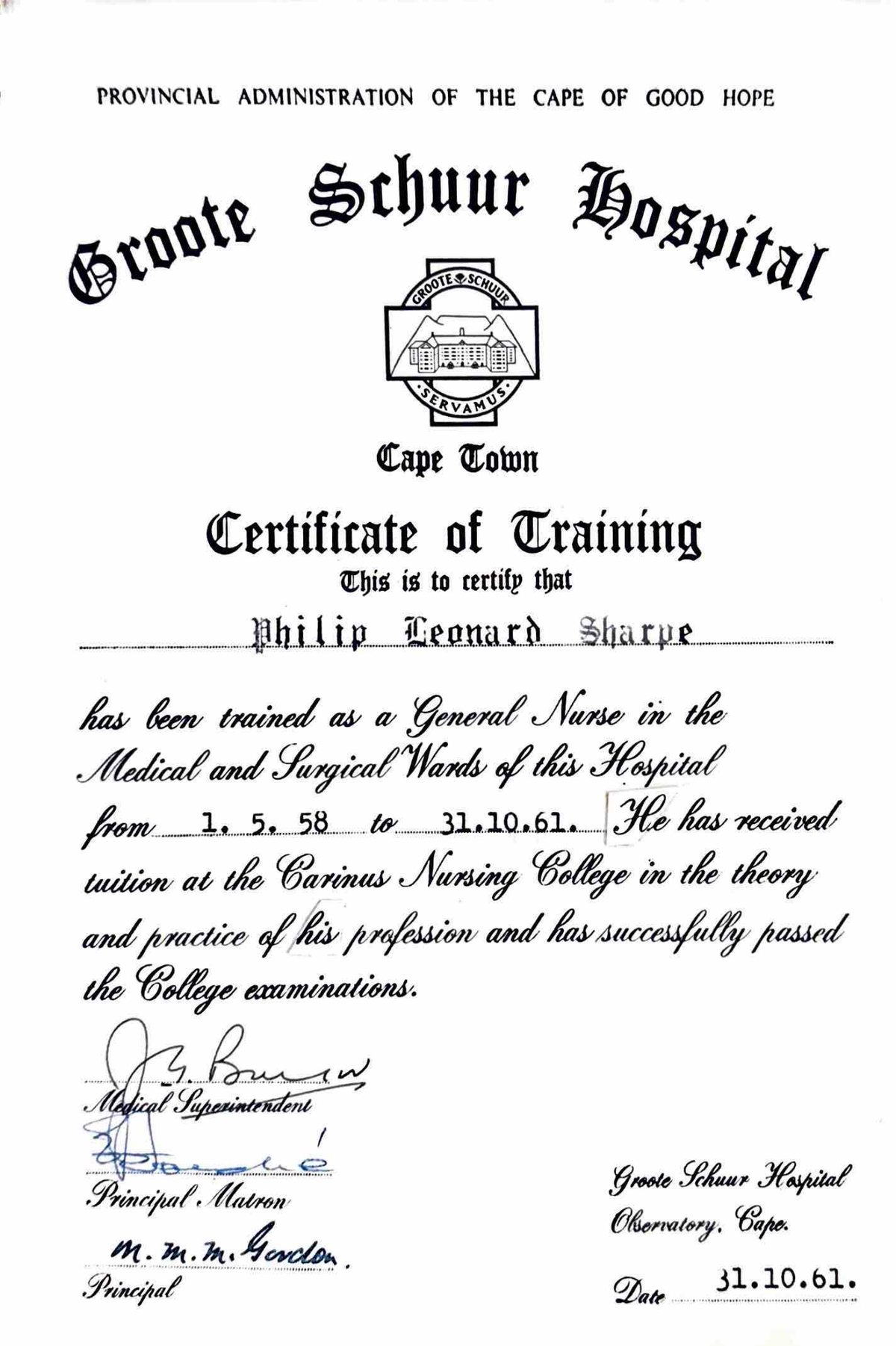
That detail makes the story more meaningful to me, because it connects the headline to the institution around it.
Behind Barnard stood a hospital.
Behind the operation stood decades of medical progress.
Around the patient stood nurses, doctors, technicians and specialists whose names most people would never learn.
After the chest was closed, the work continued.
That is how great human achievements are usually produced.
There is often a visible individual.
There is always a deeper system of preparation, equipment, teamwork, standards and care.
The tools deserve admiration.
The people who invented them deserve admiration.
The people who mastered them deserve admiration.
The teams who applied them deserve admiration.
And the people who stayed with the patient after the cameras had gone deserve admiration too.
AI belongs in that tradition.
It is one of the most powerful tools humanity has created.
It can extend our reach, accelerate discovery and allow exceptional people to do work on a scale that once seemed impossible.
We should use it.
We should become excellent at using it.
We should redesign work around it.
But we should not confuse the availability of intelligence on demand with the formation of wisdom, qualification or professional responsibility.
A heart-lung machine did not replace Chris Barnard.
It allowed Chris Barnard and his team to do something extraordinary.
AI should be understood in the same way.
Transplanting a human heart is trivial with the right tools
All you need is:
- A donor heart.
- An operating theatre.
- A bypass machine.
- A surgical robot.
- A complete medical library.
- A flawless checklist.
- An AI assistant.
- Someone willing to make the first incision.
Ignore the twenty-seven years of preparation.
Ignore the hundreds of supervised operations required to train a modern cardiac surgeon.
Ignore the multidisciplinary team.
Ignore the judgement built through cases that did not follow the textbook.
Ignore the ability to recognise a complication before it becomes a catastrophe.
Ignore the intensive care.
Ignore the rejection.
Ignore the infection.
Ignore the lifelong medication.
Ignore the patient after the operation.
Ignore the responsibility for the outcome.
Then transplanting a human heart is trivial with the right tools.
Clearly, it is not.